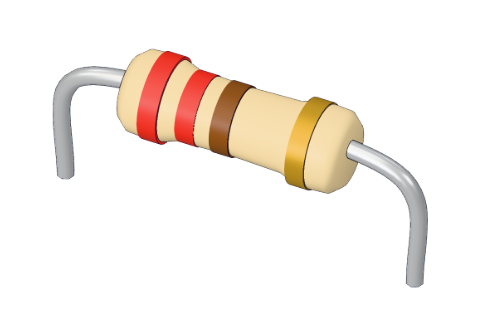
The short answer
On a common 4-band resistor:
- Band 1 = first digit
- Band 2 = second digit
- Band 3 = multiplier (how many zeros to add)
- Band 4 = tolerance (how exact it is) — usually gold (±5 %)
So red, red, brown, gold = 2, 2, one zero = 220 Ω, ±5 %.
The color code table
| Color | Digit | Multiplier | Tolerance |
|---|---|---|---|
| Black | 0 | × 1 | — |
| Brown | 1 | × 10 | ±1 % |
| Red | 2 | × 100 | ±2 % |
| Orange | 3 | × 1 000 (1 k) | — |
| Yellow | 4 | × 10 000 (10 k) | — |
| Green | 5 | × 100 000 (100 k) | ±0.5 % |
| Blue | 6 | × 1 000 000 (1 M) | ±0.25 % |
| Violet | 7 | — | ±0.1 % |
| Grey | 8 | — | — |
| White | 9 | — | — |
| Gold | — | × 0.1 | ±5 % |
| Silver | — | × 0.01 | ±10 % |
The digits follow the rainbow, with black and brown in front and grey and white behind. A popular memory line for 0 to 9: "Better Be Right Or Your Great Big Venture Goes Wrong" — black, brown, red, orange, yellow, green, blue, violet, grey, white.
Which end do I start from?
Hold the resistor so that the gold or silver band is on the right. That band is the tolerance, so you read from the other end. The tolerance band also usually has a slightly bigger gap before it. If there is no gold or silver band, start from the end where the bands sit closest to the edge.
Worked example 1: 220 Ω (for LEDs)
| Band | Color | Means |
|---|---|---|
| 1 | Red | 2 |
| 2 | Red | 2 |
| 3 | Brown | × 10 (one zero) |
| 4 | Gold | ±5 % |
2, 2, add one zero → 220 Ω. This is the resistor in front of almost every LED on this site, from Blink to the RGB LED. With ±5 %, the real value can be anywhere from 209 Ω to 231 Ω — no problem at all.
Worked example 2: 1 kΩ
| Band | Color | Means |
|---|---|---|
| 1 | Brown | 1 |
| 2 | Black | 0 |
| 3 | Red | × 100 (two zeros) |
| 4 | Gold | ±5 % |
1, 0, add two zeros → 1 000 Ω = 1 kΩ. Our DC motor project uses a 1 kΩ resistor between pin 6 and the transistor's base.
Worked example 3: 10 kΩ
| Band | Color | Means |
|---|---|---|
| 1 | Brown | 1 |
| 2 | Black | 0 |
| 3 | Orange | × 1 000 (three zeros) |
| 4 | Gold | ±5 % |
1, 0, add three zeros → 10 000 Ω = 10 kΩ. This is the pull-down in the push button project and the partner of the light sensor in the night light.
5-band resistors
Precision resistors (often with a blue body) have three digit bands, then the multiplier, then the tolerance — usually brown (±1 %).
| Resistor | 4-band | 5-band |
|---|---|---|
| 220 Ω | red red brown gold | red red black black brown |
| 1 kΩ | brown black red gold | brown black black brown brown |
| 10 kΩ | brown black orange gold | brown black black red brown |
For 220 Ω on a 5-band resistor: 2, 2, 0, then black (no more zeros) → 220 Ω.
Quick ways to check
- A multimeter on the Ω setting gives the real value in a second. Don't hold both legs with your fingers — your body adds resistance.
- Keep them sorted. Tape a strip of each value to a card and write the value on it.
- In our 3D lab you can set each resistor's resistance on the Build bench — handy for seeing how 220 Ω, 1 kΩ and 10 kΩ change an LED's brightness.
Check yourself
What value is brown, black, orange, gold?
1, 0, then orange = three zeros: 10 000 Ω.
What colors are on a 220 Ω 4-band resistor?
2, 2, and brown adds one zero: 220.
What does a gold fourth band mean?
In the fourth position, gold is the tolerance: ±5 %.
Questions people ask
How do you read a resistor color code?
Put the gold or silver band on the right. The first two bands are digits, the third tells you how many zeros to add, and the last is the tolerance. Red-red-brown is 2, 2 and one zero: 220 Ω.
What is the color code for a 220 ohm resistor?
On a 4-band resistor: red, red, brown, gold. On a 5-band resistor: red, red, black, black, brown.
What color is a 10k resistor?
Brown, black, orange, gold on a 4-band resistor; brown, black, black, red, brown on a 5-band one.
Does it matter which way round a resistor goes?
No. A resistor works the same in both directions, so you can push it into the breadboard either way. The direction only matters for reading its bands.
Build it yourself in 3DFree, in your browser — no board, no wires, nothing to buy.Open the 3D lab →Your progress stays on this device — no account, nothing sent anywhere.
Last updated 2026-10-29